Inventions & patents
What was invented in Soest
A hitch that finds its own way. A tube with waves in it. A sluice that stands upright. A disc that cleans another disc. The most important developments – and the problem each of them solved.
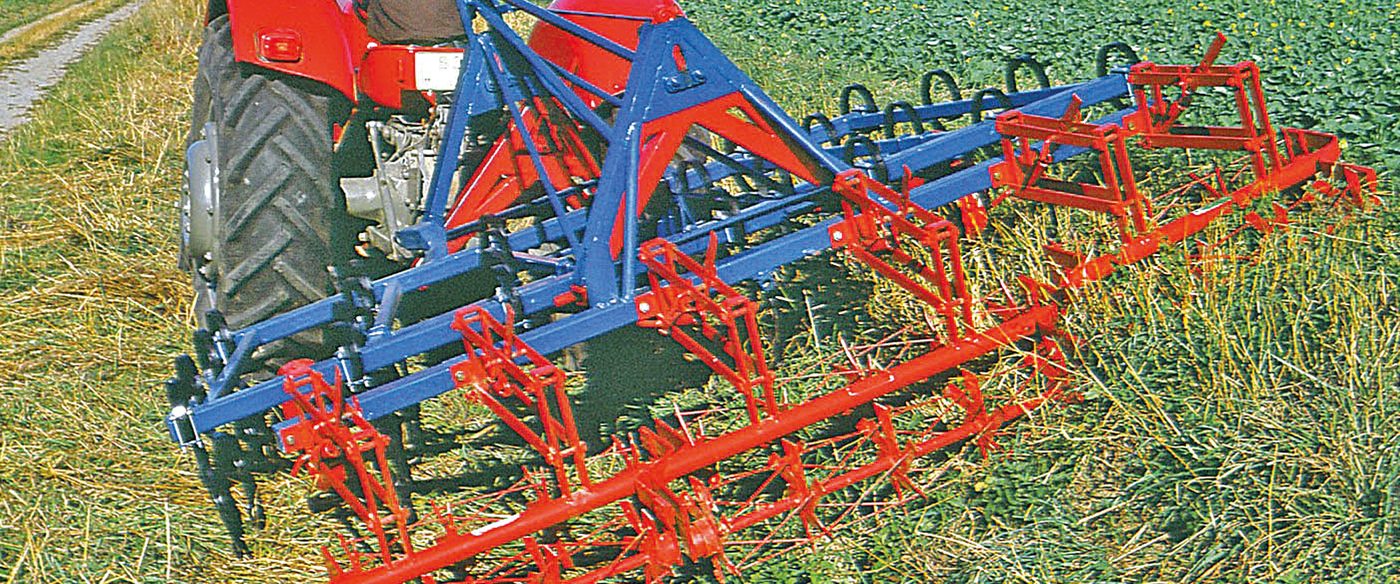
The quick-hitch triangle, 1964
The problem. Ever since Harry Ferguson invented the three-point linkage in 1933, tractors and implements had grown steadily larger. Hitching up was still done by hand, between the back of the tractor and the implement – and it had become dangerous. Helmut Weiste found that out in 1963 with his own leg.
His father's hook coupling helped only so far: it would engage at angles of up to five degrees and a lateral offset of at most three centimetres.
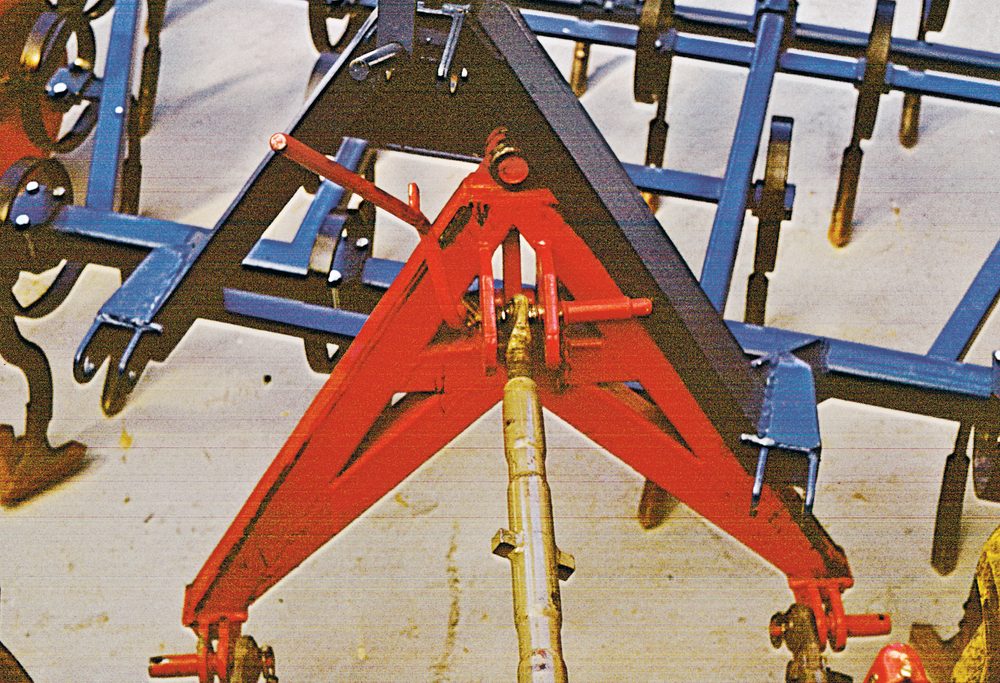
The thought. To connect them, the three coupling points must be brought into coincidence in a common plane. At the drawing board the apprentice slid two triangles drawn on tracing paper into one another. The question remained how the forces should be transmitted.
The answer. A 40 mm square tube lying in a 60 mm U-section. Make the implement triangle from downward-open U-section and the tractor triangle from matching square tube, and the profiles become both catching elements and positive connecting elements at once. With a roller at the tip and a longer telescopic top link, the finished design would still couple at 25 degrees of tilt and 30 centimetres of offset.
As if by magic the implement moved into position and … click, it was coupled.Helmut Weiste on the first demonstration, 24 February 1964
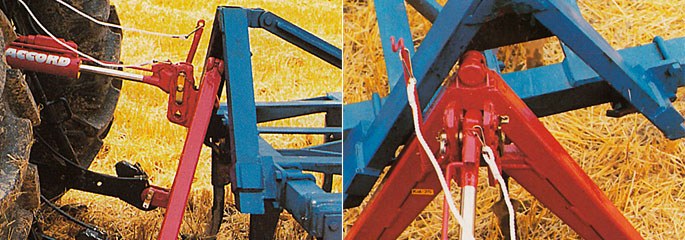
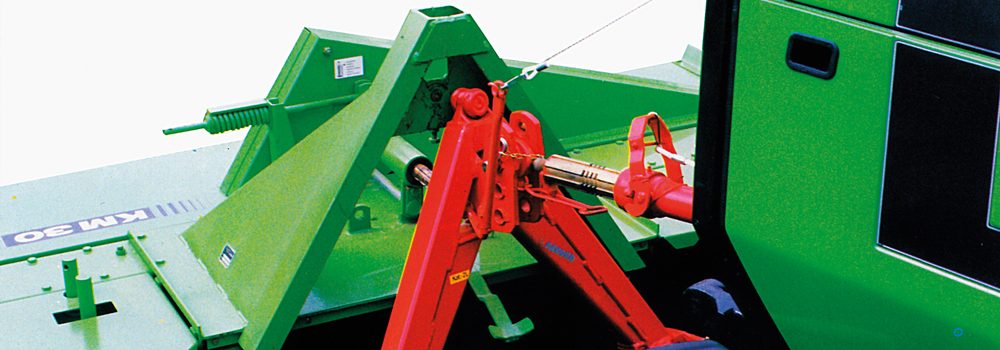
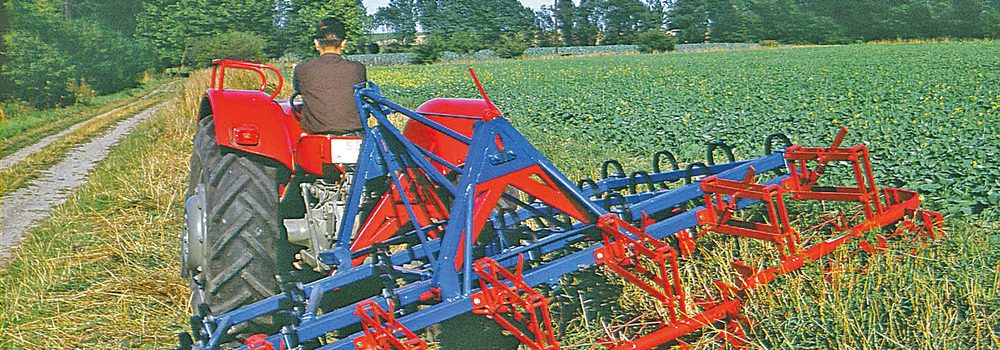
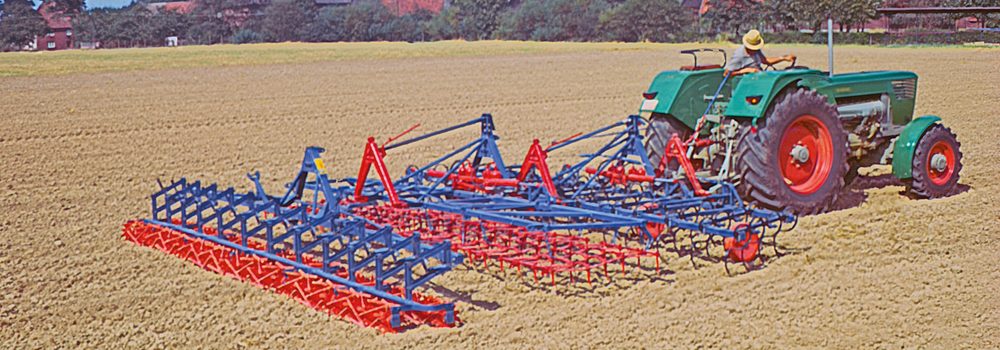
German patent no. 1 215 419, filed on 3 March 1964. Later standardised internationally as the A-frame coupler, ISO 11001-2. A mini triangle for compact tractors was made under licence by Hako; once the patent expired, Iseki and Kubota copied it – it can still be seen on municipal machinery today.

The corrugated-tube distributor, 1965
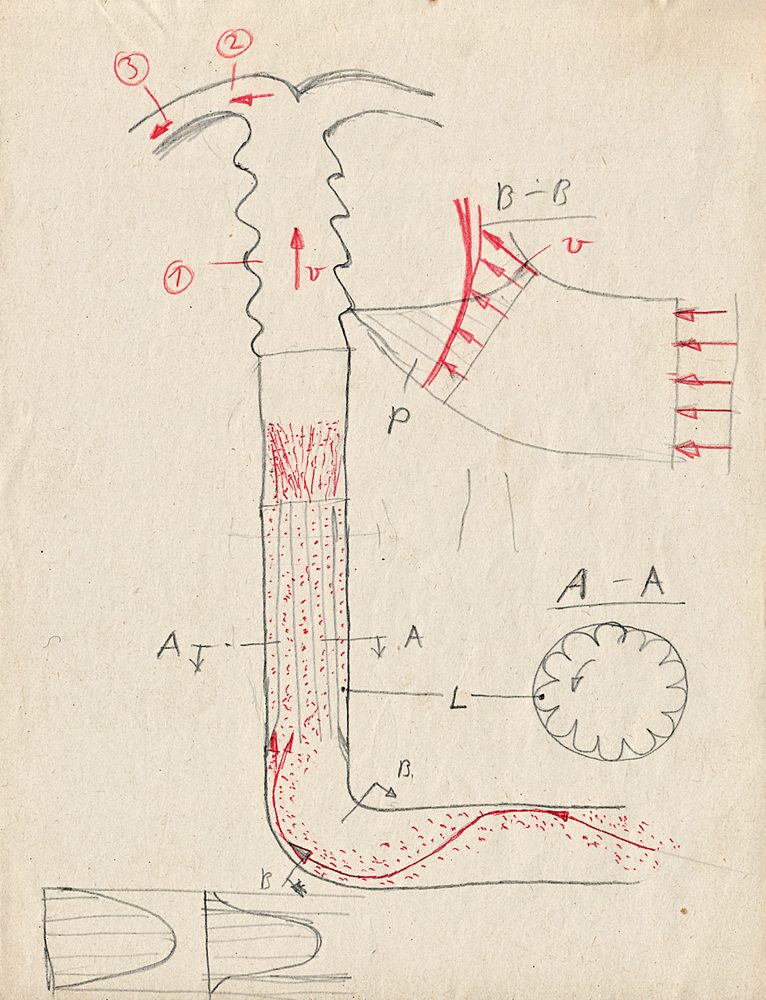
The problem. Air does not carry grains evenly. In every bend, centrifugal force presses them against the outer wall; in the straight section a swirl remains. A distributor then divides not grains but streaks.
The answer. Four elements working together:
- Central metering of the seed into a pneumatic delivery line.
- The corrugated tube ahead of the distributor swirls the grains evenly across the cross-section.
- Radial guide plates in the elbow steer the grain stream into the middle of the bend.
- Longitudinal guide plates in the rising tube eliminate the swirl.
The first corrugations were hammered into a copper tube in a matter of hours by Ernst Ullmann, a fitter who had trained as a coppersmith in Bohemia. The problem itself was made visible with his own stroboscope lamp.
Filed in 1966 as three German applications, combined in 1967 into one combination patent and filed in 35 countries – among them GB 1 176 201, “A device for Distributing Agricultural Material”. The corrugated-tube distributor appears in it only under figures 7 and 8. The breadth of the patent became its weakness: anyone using only individual features did not infringe it.
And there was more: Heinrich Weiste filed the patent in his own name. His son was not even entered as a co-inventor.
The vertical injector sluice, 1968
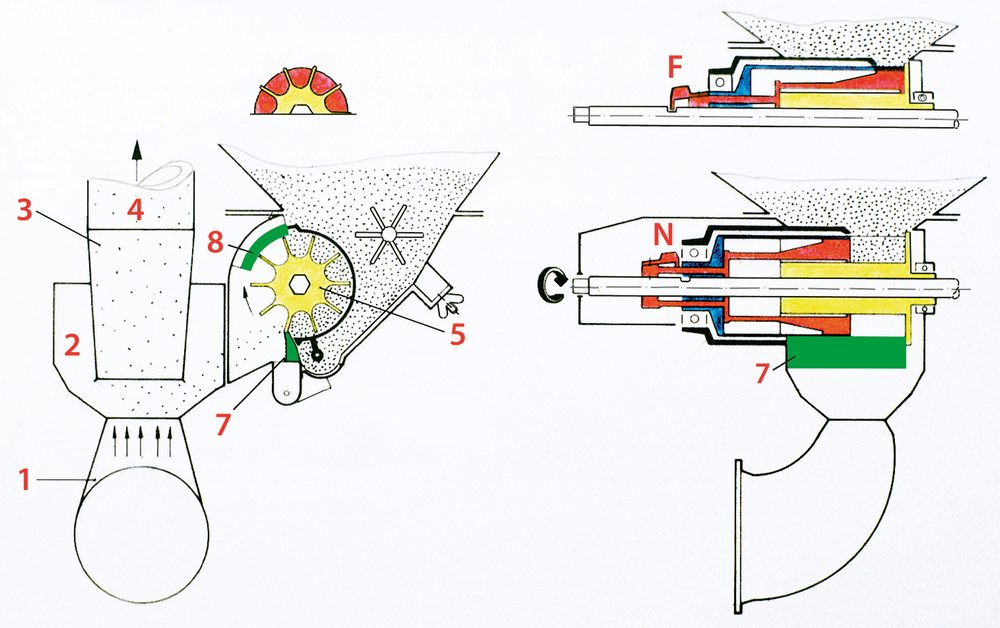
The problem. The first ten-metre fertiliser spreader managed 60 kilograms a minute. At least 120 were needed. At the same time the heavy granules had to be distributed evenly across the cross-section over a very short distance.
The answer. An upright injector sluice with an annular chamber: high output, good distribution and a compact design with a single main distributor. Unlike horizontal sluices, the diffuser is short and has a wide expansion angle of 11 degrees; the inlet sits close to the nozzle.
Nine years later this very component turned out to be the ideal solution for the second-generation DL seed drill – and halved its distribution error.
British patent no. 1 205 724. In 1978 ACCORD supplied the injector sluice for Friggstad's air seeder in Canada.
The electric tramline control, 1977
The problem. Tramlines are deliberately unsown wheelings for the fertiliser spreader and the sprayer. Competitors engaged and disengaged individual seed wheels with large mechanical mechanisms. One switching error produces the wrong tramlines – and they are sown fast.
The answer. Shut-off flaps in the seed hose, operated by a solenoid. The rhythm is then switched purely electrically – freely, variably and easily changed. For the first series an ordinary rotary switch from the shop had to do.
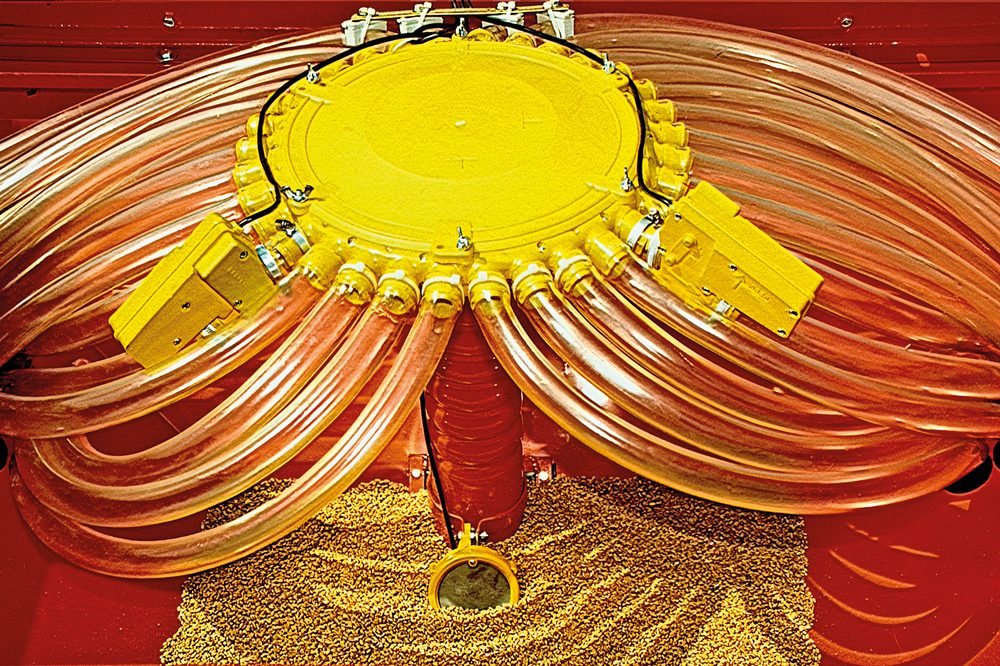
Three years later Ferdinand Schumacher senior, an engineer at ACCORD and a hobby electronics enthusiast, built the first circuit with integrated circuits in his spare time: six tramline rhythms on one knob, LEDs for the flaps, a yellow lamp for a nearly empty hopper.
A side effect that changed the industry
In practice the electronics kept failing. The cause was banal: tractors had no 12-volt socket, only a cigarette lighter with unreliable contacts. Helmut Weiste raised the matter in the association's technical committee. Against the resistance of the tractor manufacturers it took eight years until the three-pin plug DIN 9680 was standardised in 1988. The same initiative later produced the signal socket DIN 9684-1, the standard ISO 11786 and eventually ISOBUS (ISO 11783).
The oblique-vane final distributor, 1983
The problem. In a pneumatic fertiliser spreader the granules were repeatedly slowed down – in the distributor, in the bends and on the impact plate. The spread pattern was only two to three metres wide; eighteen metres would have required a great many lines.
The answer. A final distributor of five curved guide vanes whose oblique cut creates several overlapping fans. The aerodynamic energy of the granule stream is used in full: eight metres per distributor. Add to that a lightweight solution for the booms – the large aluminium delivery tubes are also the load-bearing spars.
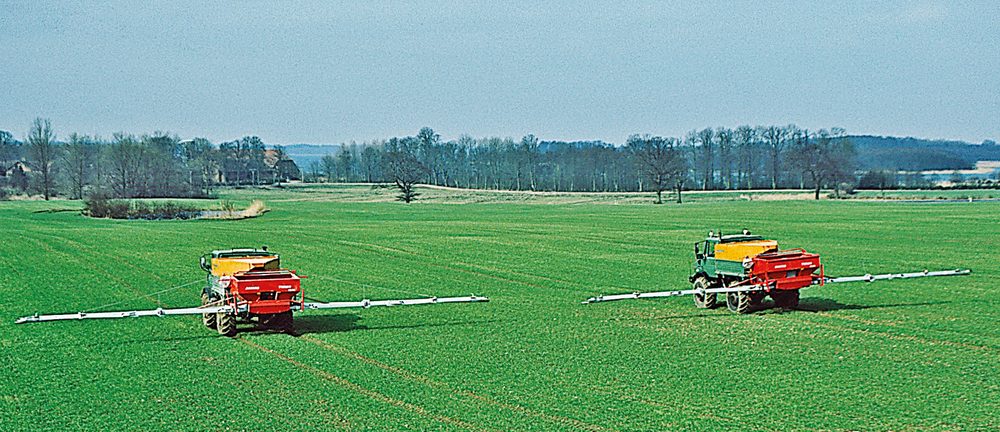
Published in Grundlagen der Landtechnik, volume 38 (1988), no. 2.
The CX disc coulter, 1992
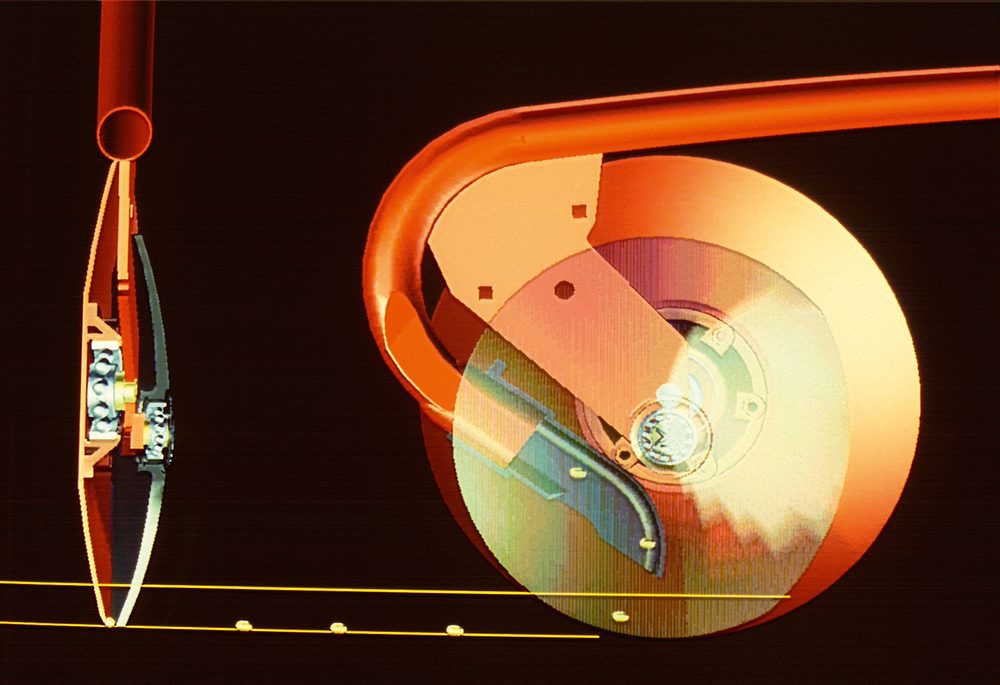
The problem. With mulch seeding came late-autumn sowing on wet soils. On clay, the coulter discs clogged, stopped turning and rolled across the field inside a thick pot of earth without cutting a furrow at all. Scrapers acted like drum brakes. The competition had exactly the same trouble.
The test rig. Since field trials are possible only once a year, an old “roundabout” was put back into service: an annular soil trough some three metres across that turns like a carousel. Filled with clay soil, maize straw and water, clogging could be reproduced at any time.
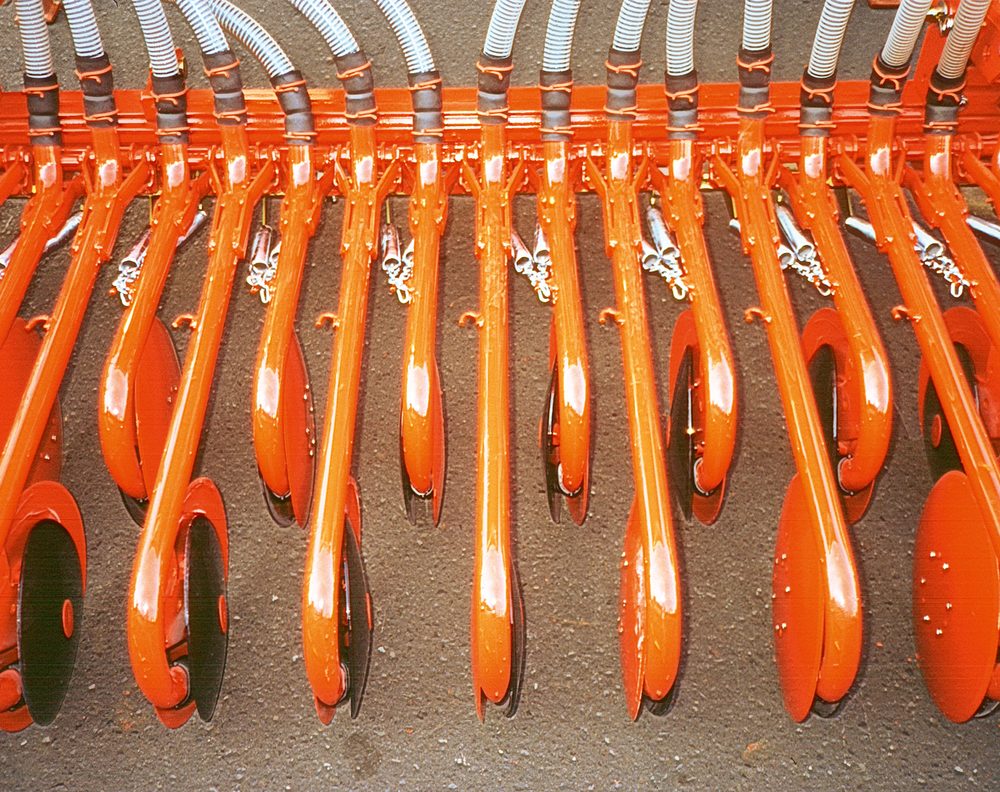
The answer. Gerd Stüttgen had the decisive idea of replacing the coulter shoe with a flexible disc – inspired by the feed discs of the old planting units. The student Bernd Schwarte replaced the flat steel disc with a dished one, convex side outwards, so that the soil flows around it in a streamlined way. The flexible plastic disc turns in the shelter of the steel disc and cleans it by flexing.
- Clog-free on every soil – the discs always turn
- The seed duct sits protected between the dished discs and places the grain on the furrow bottom
- Up to 15 km/h without ridging; row spacings from 9.5 centimetres
Six years of litigation
Amazone and Kuhn filed oppositions in 1994. The German patent was upheld at first but revoked in 1996; the European followed in 1998. The decisive document was an American patent describing two hard, flat steel discs with toothed rims whose rolling produces a flexing action – rendered by the opposing party as “flexible disc”.
The newly instructed patent attorney Dr Thomas Becker refuted this. On 20 September 2000 the Technical Board of Appeal of the European Patent Office overturned the revocation. EP 0 579 909 stood.
An injustice that remains
In 1993 the Agritechnica jury classified the CX coulter merely as a “noteworthy further development”. In 1999 the same jury awarded a silver medal to a competitor's copy of it. After winning the case, ACCORD nevertheless did not forbid its use, but granted a licence.
Further developments
| Year | Development | In brief |
|---|---|---|
| 1970 | Hydraulic top link | A world first: locked from the tractor seat, float position, electric length setting (DE 2 025 040) |
| 1972 | Guide devices in the S-bend | Eliminate the swirl in the flow (DE 22 56 939) |
| 1976 | DL module system | One seed cart, interchangeable coulter rails – one frame for every working width |
| 1982 | Seed rate adjustment | An electric motor raises the rate by up to 20 per cent at the touch of a button |
| 1982 | Band coulter | A slip-on shoe spreads the grains in a band 7 cm wide |
| 1984 | Stop and half-width shut-off | A wrap spring clutch disconnects the metering shaft at the headland |
| 1985 | Micro metering | A switchable reduction – oilseed rape from 2 kg/ha |
| 1988 | Profiled disc coulter | Dished rim, scraper above (DE 38 08 916, EP 0 332 856) |
| 1988 | Electronic rate control EMR | Spread rate governed by forward speed, three calibrations storable |
| 1989 | OPTIMA frame | Free arrangement of seeding rows including fertiliser coulters, narrow rows possible (EP 0 356 606) |
| 1990 | Electronic seed drill control ESC | Twenty tramline rhythms, continuous monitoring, visual and audible warning |
| 1998 | Flat elbow | Splitting the stream in a flat bend: CV from 7.2 to 2.3 per cent (EP 0 956 757, US 6 443 671) |
| 1998 | Electronic seed drill drive ESA | A 12 V motor drives the metering shaft in proportion to ground speed – with DGPS, site-specific |
Recognition
Tilo Freiherr von Wilmowsky medal in gold
Awarded by the KTBL on 22 April 1998 in the Imperial Hall of the Würzburg Residence. Helmut Weiste is the third recipient from industry – after Hermann Fendt and Anton Schlüter.
“… in recognition of his outstanding services to the mechanisation of agriculture as an innovative designer and medium-sized entrepreneur, in particular for the development of pneumatic distribution techniques with central metering, which have found application worldwide.”
Carl Heinrich Dencker pin of honour
Society for the Advancement of Agricultural Engineering, Bonn, 23 May 2001.
“With the invention of a novel seeding principle, Mr Helmut Weiste decisively influenced pneumatic drilling technology, its introduction, and today's drilling technology for large working widths.”
To these may be added three silver medals of the Royal Agricultural Society, presented at the Royal Show of 1988 for the triangle coupling, the DL seed drill and the MONOPILL – and, right at the beginning, the gold medal of the USSR Chamber of Commerce, awarded to Heinrich Weiste in Moscow in 1966.