
The technology
The ACCORD PNEUMATIC system
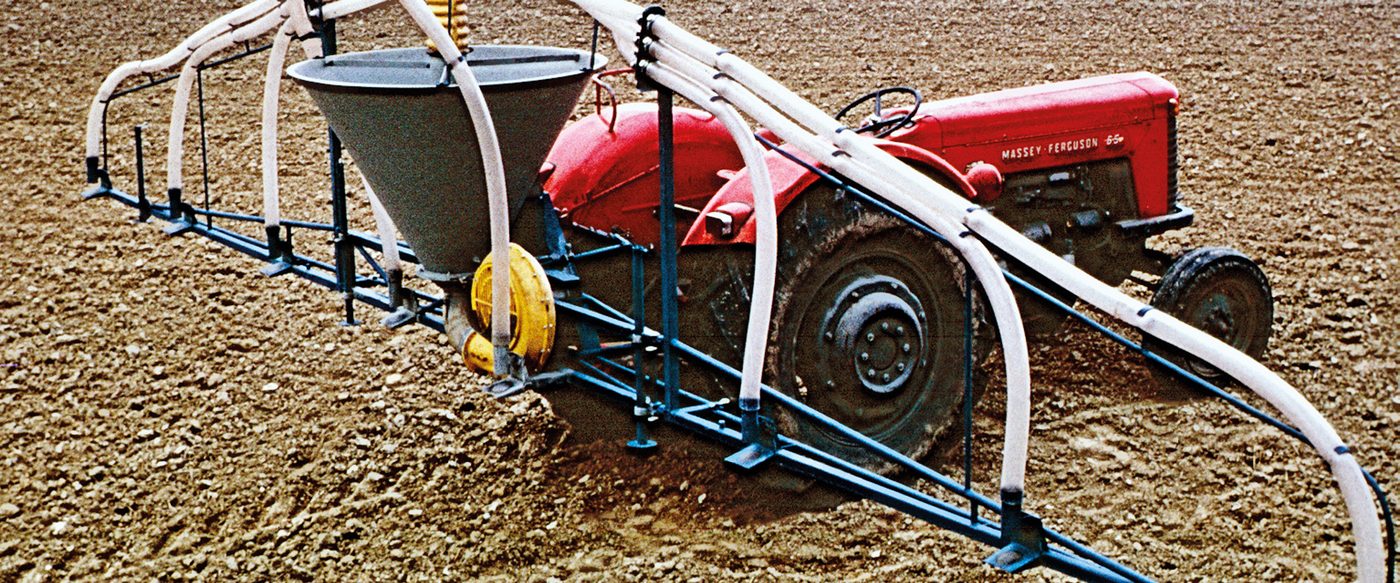
Since 1785 seed drills had metered the seed with many small seed wheels and let it fall in rows. The ACCORD system reverses the principle: one metering unit for the whole working width, a stream of air as the means of transport, and a distributor that divides that stream. This allows the seed hopper to be separated from the coulters – and everything else follows from that.
The path of the grain
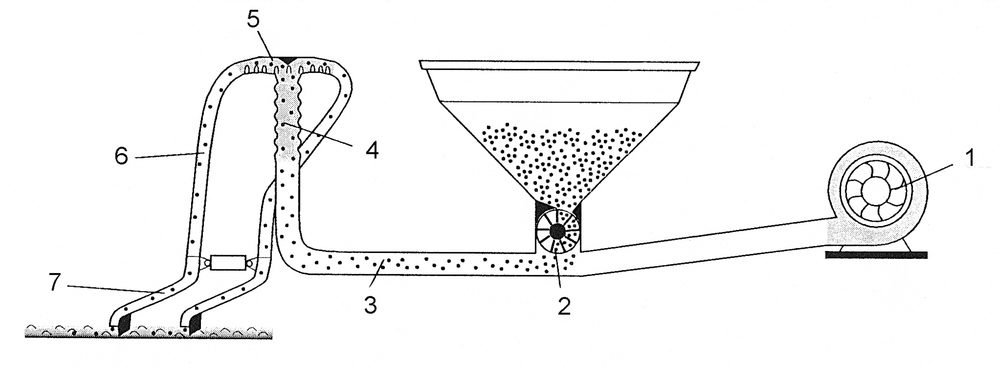
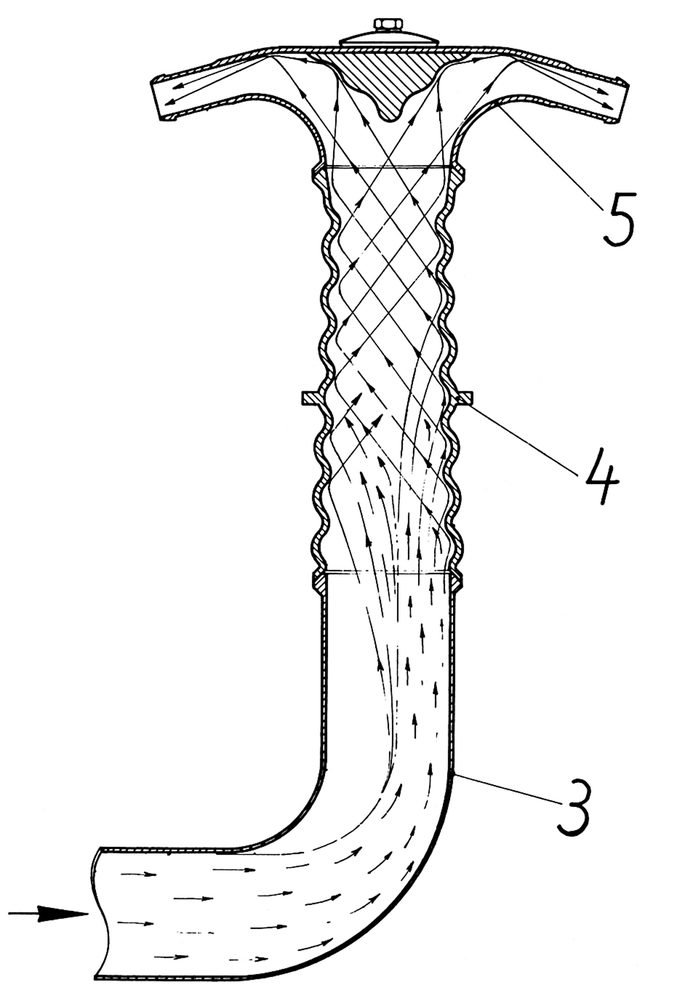
The fan (1) generates the air stream. The metering unit (2) feeds the seed into the delivery line (3). On its way up, the grain-and-air mixture passes through the corrugated tube (4), which swirls the grains evenly across the whole cross-section. The distributor (5) divides the stream between the seed hoses (6) leading to the coulters (7).
The crucial point sits inside the corrugated tube. A grain-and-air mixture is a two-phase flow: the grains do not fly obediently down the middle but gather – driven by centrifugal force and swirl – in streaks along the wall. A distributor that divides such a stream does not divide evenly. The corrugation mixes the grains again beforehand.
Three features
Central metering
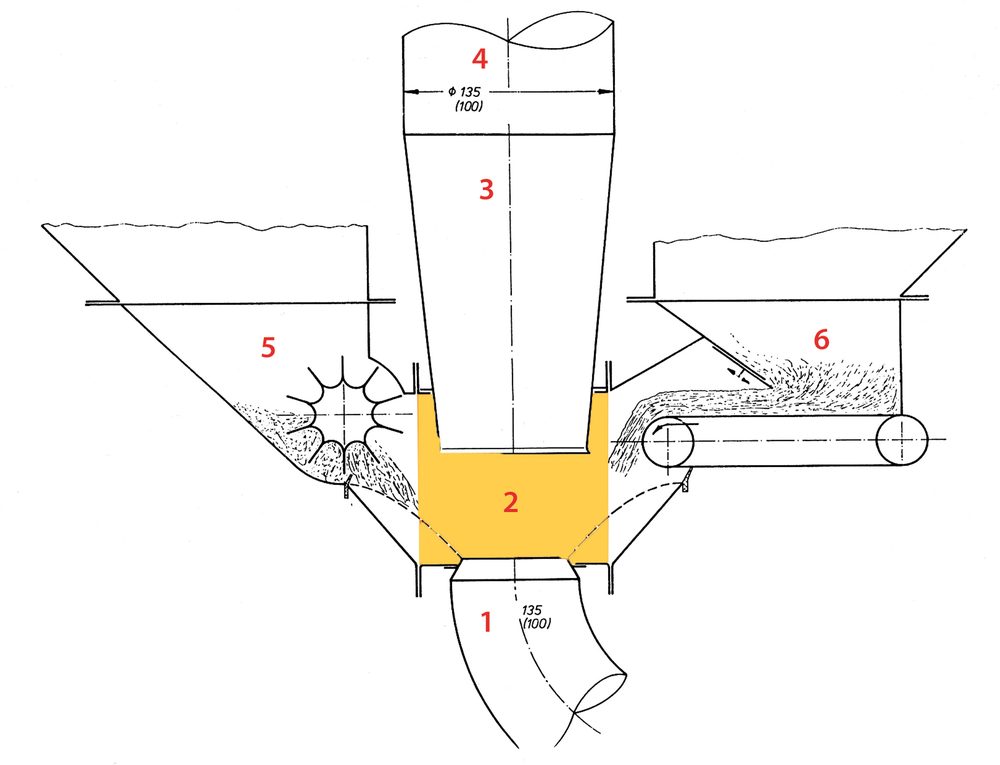
From a central hopper, a single closed cell wheel meters for the whole working width – exactly by volume, from oilseed rape through cereals and maize to peas and beans. What has been calibrated is what goes out: regardless of forward speed, vibration or slope. Up to 12 km/h the delivery rate is virtually 100 per cent.
On the DL generation the cell wheel is sealed by a rubber lip below and a nylon brush above. That prevents grain damage – an English farmer had watched his beans being sheared off against the earlier rigid sealing shell.
Pneumatic distribution
Because the air stream carries the seed, the coulters can sit where they belong agronomically – not where the seed box happens to be. From this follow applications that are simply impossible with mechanical drills:
- Broadcast sowing beneath sweeps, straight onto the moist layer of soil
- Fertiliser placed below or beside the seed by a combined seed-and-fertiliser coulter
- Fertiliser or fine herbicide granules spread broadcast above the soil by impact plates
- Seed and fertiliser mixed in one line – or kept apart in two
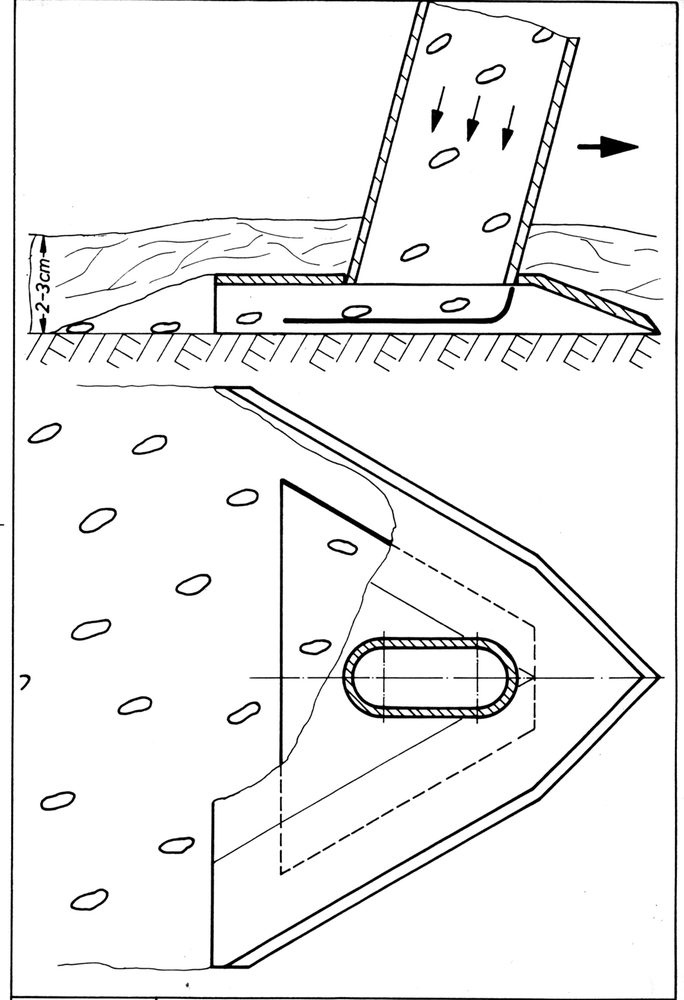
A separated hopper
Hopper, metering unit and fan form a compact unit carried by a vehicle: the tractor, a front tank, or a trailed tank cart. Different implements can be coupled to it, with different coulters and cultivation tools. In 1966 many visitors to the field day thought this utopian. Twenty years later it was the reason ACCORD could build the DF front-tank drill: at four and six metres of working width the load on the rear wheels had become so great that deep ruts and soil compaction were the result.
How accurate is accurate?
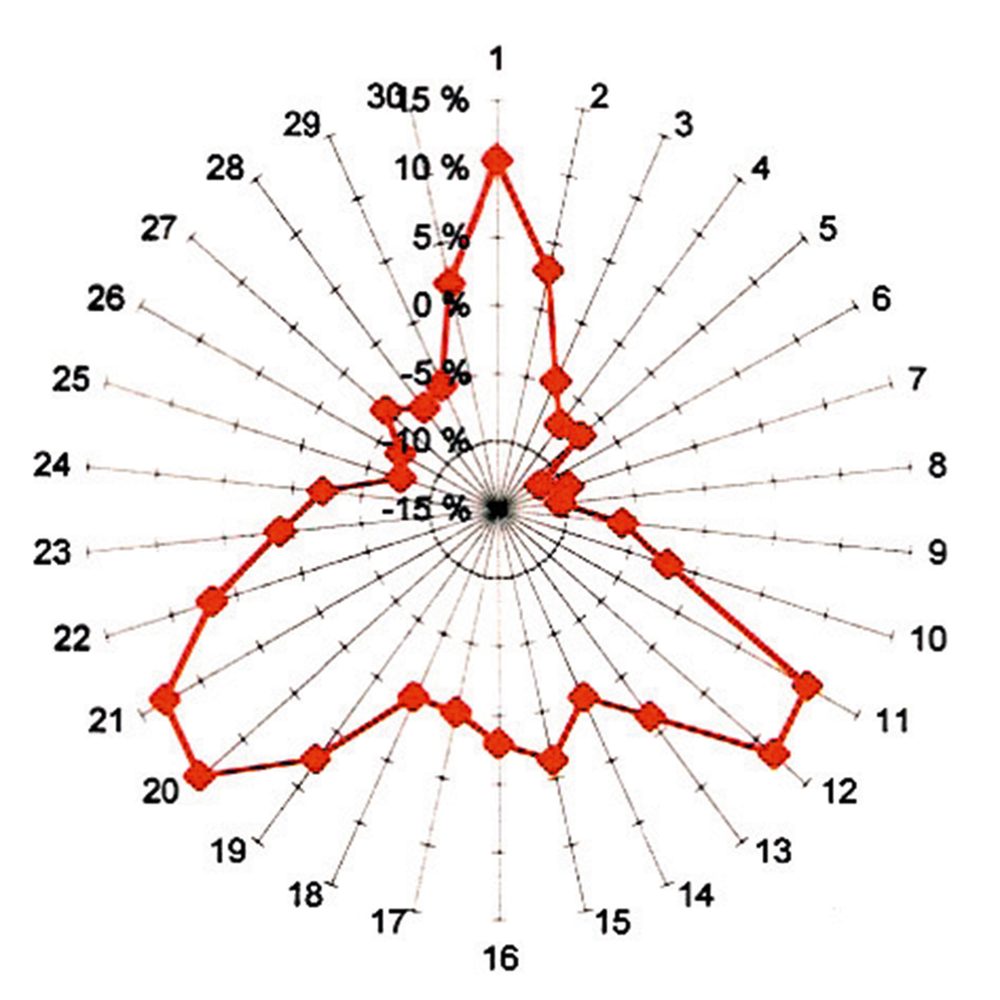
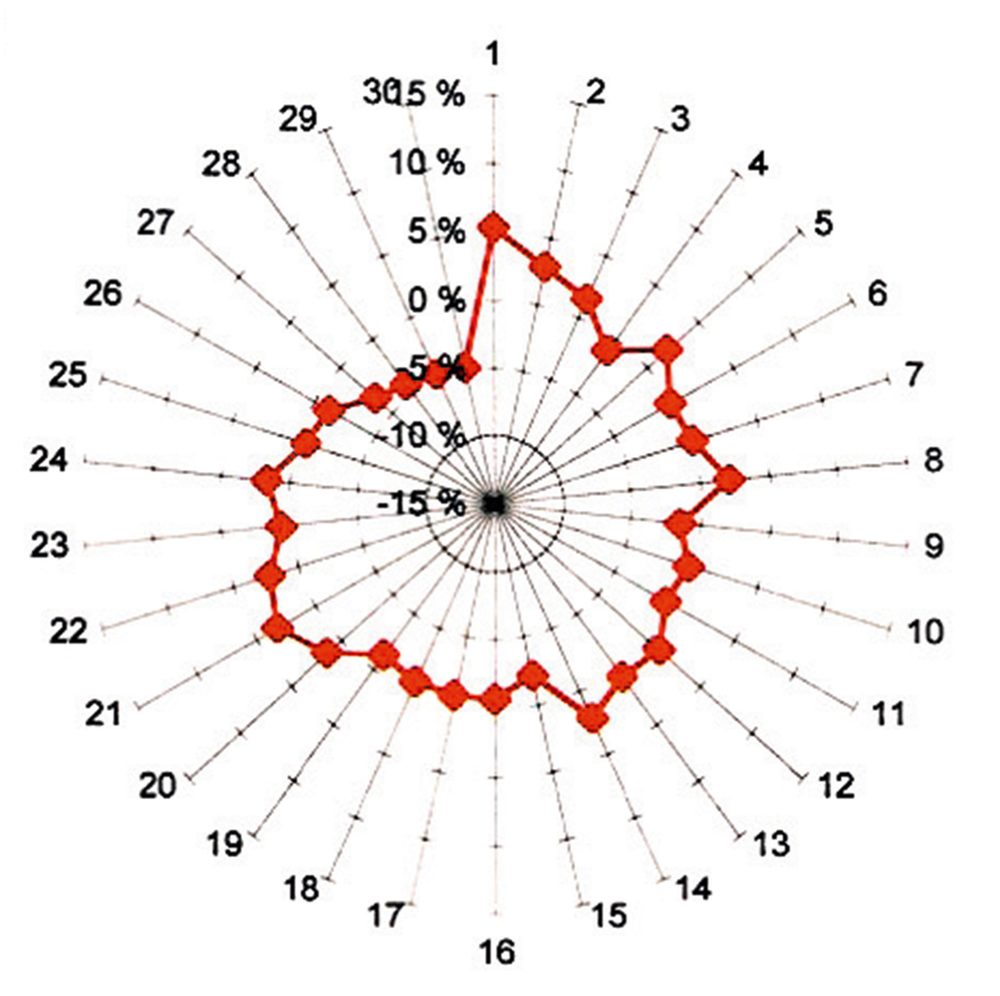
The quality of transverse distribution is measured as a coefficient of variation (CV) – the smaller the better. The history of the system is the history of that number:
| Solution | Year | Deviation |
|---|---|---|
| Cyclone distributor | 1965 | 30–50 % |
| Impact distributor | 1965 | ±30 % |
| Delivery tube flattened crosswise | 1965 | ±10–15 % |
| Hammered copper corrugated tube | 1965 | ±5–8 % |
| Corrugated tube with radial guide plate | 1965 | +4.4 / −2 % |
| DS with primary and secondary distributors | 1968 | CV 6–10 % |
| DL with vertical injector sluice | 1977 | CV 2–5 % |
| Round elbow (trailed machines) | before 1998 | CV 7.2 % |
| Flat elbow | 1998 | CV 2.3 % |
For comparison: by the assessment scale of the DLG a CV above 6.3 per cent is insufficient; a rating of “good” goes to anything between 2.0 and 3.2. The old Saxonia drill with cam seed wheels measured 7 to 10 per cent in 1965, the then-new Stockland with a centrifugal distributor 15 to 18.
What it means in the field
The economic advantage was obvious from the start: more working width, fewer passes. The ecological advantage came later – and became decisive.
Economic
- Cultivating, sowing and fertilising in a single pass
- 50 to 60 per cent less working time and energy (Australia, 1971)
- Fast central filling instead of many small boxes
- Sowing within the short optimal window
Ecological
- Wind erosion is prevented because the soil is hardly moved
- Less water lost to evaporation
- Seed on the moist layer – better germination conditions
- Crop residues stay on the surface
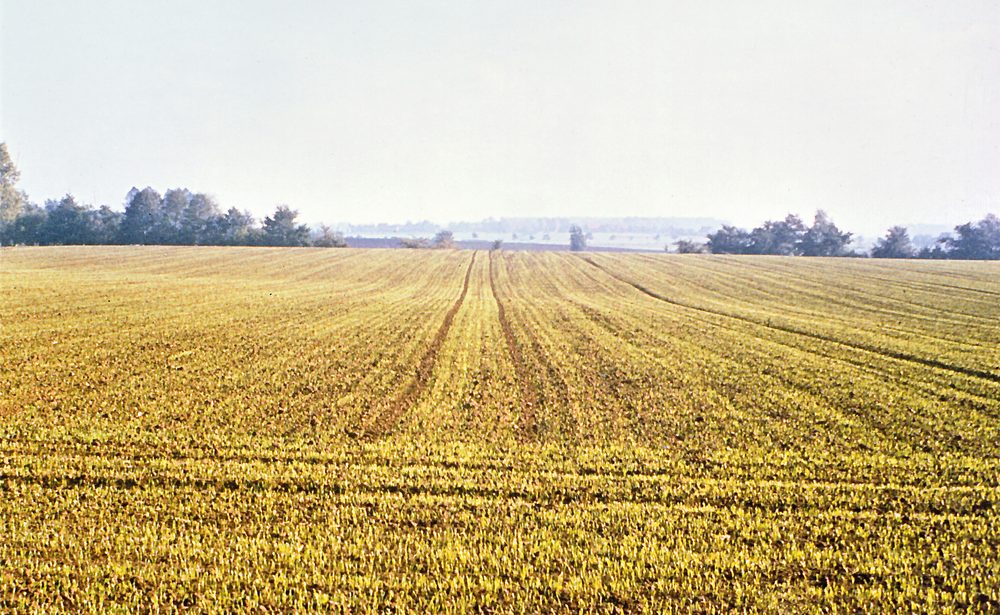
The studies by Professor Hermann Heege and Jürgen Mahlstedt at the Institute of Agricultural Engineering in Bonn, and later at the University of Kiel, supplied the figures: broadcast sowing gave on average 7.6 per cent more grain yield than drilling at 15 cm row spacing – provided the seed is covered evenly. Comparing yields at different coulter spacings, drilling scored 100, band sowing 104 and broadcast sowing 107 per cent.
And the objections?
At the field day of 1966 there was praise – and scepticism. What use were ten-metre seed drills on a German farm averaging ten hectares? Does air really distribute evenly? Is the seed dressing blown off? Does the impact damage the germ?
The objections were fair, and some of them were paid for dearly. The first series reached the market too soon. Only after the complaints of 1969 was the flow understood well enough to be controlled. The institutes helped only up to a point: the Bonn study that certified poor distribution, and was quoted in the trade press for years, had not been carried out with original components and without guide plates in the bends.
Air seeding has taken the world by storm and is really one of the few major advances that have been made, changed an industry. Terry Friggstad, air seeder designer and the first user in Canada
One sentence that explains everything
“In searching for a new seeding system I had to put myself inside the elusive flow of air and
grain – and investigate the inexplicable deviations in distribution.”
Helmut Weiste on the summer of 1965